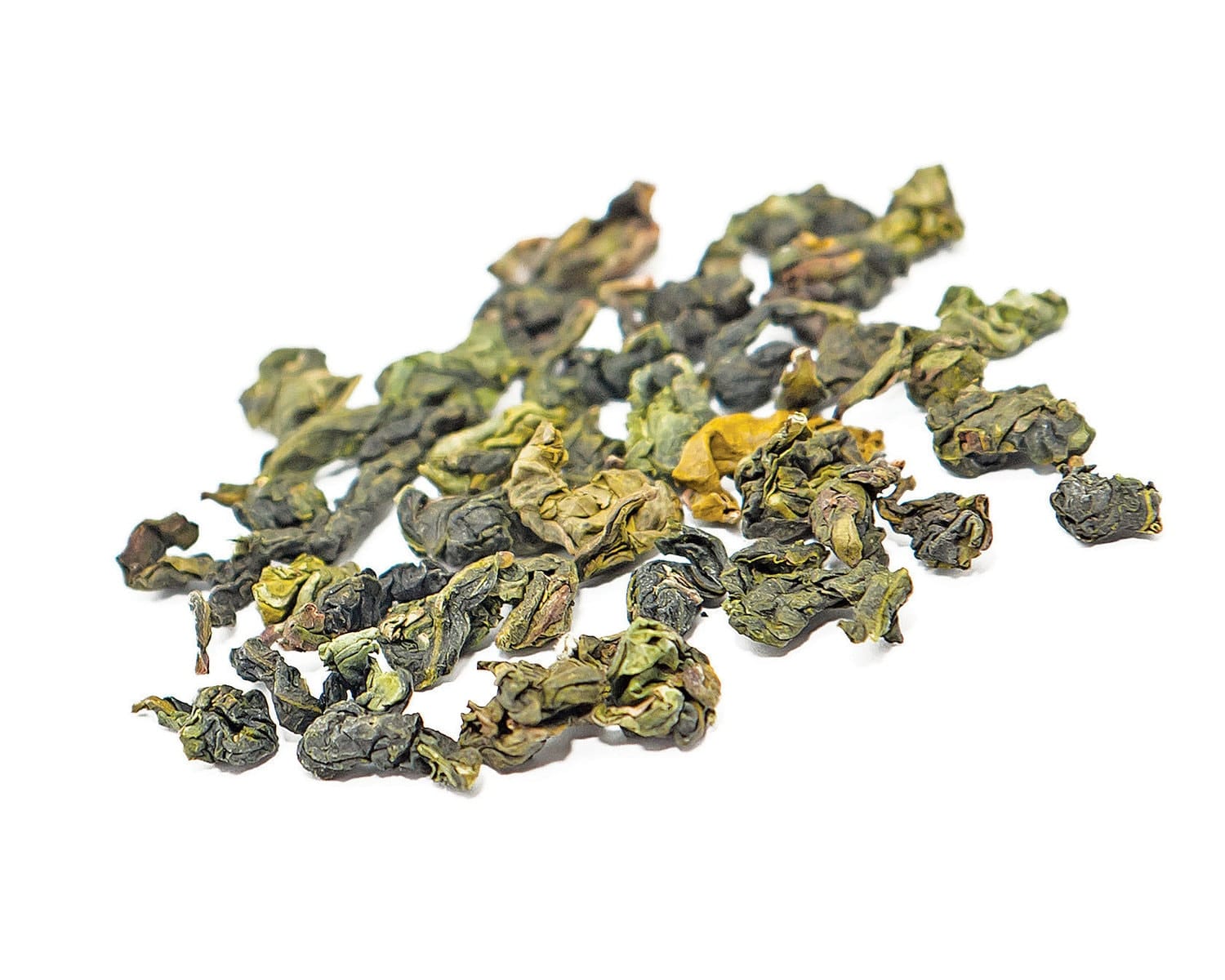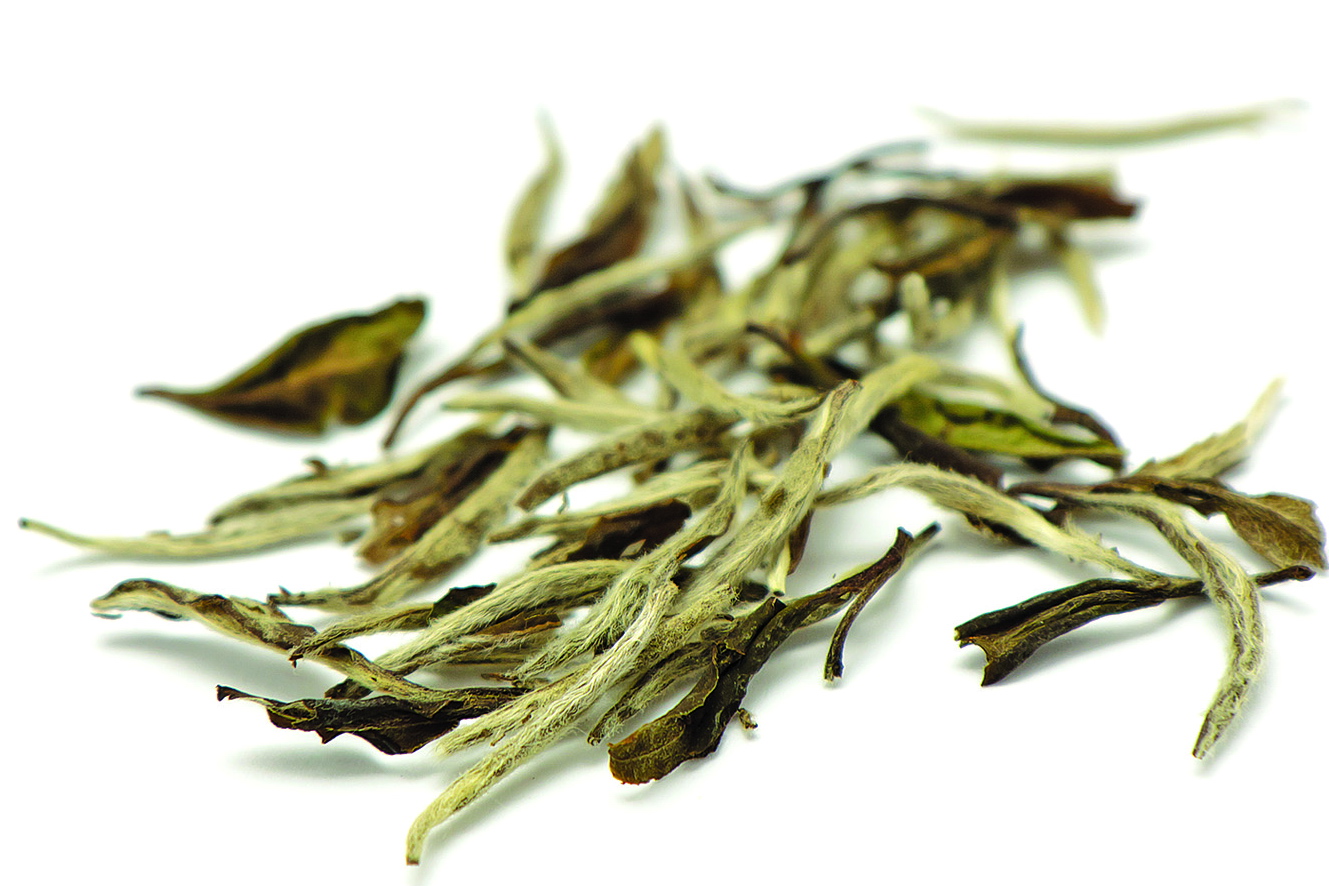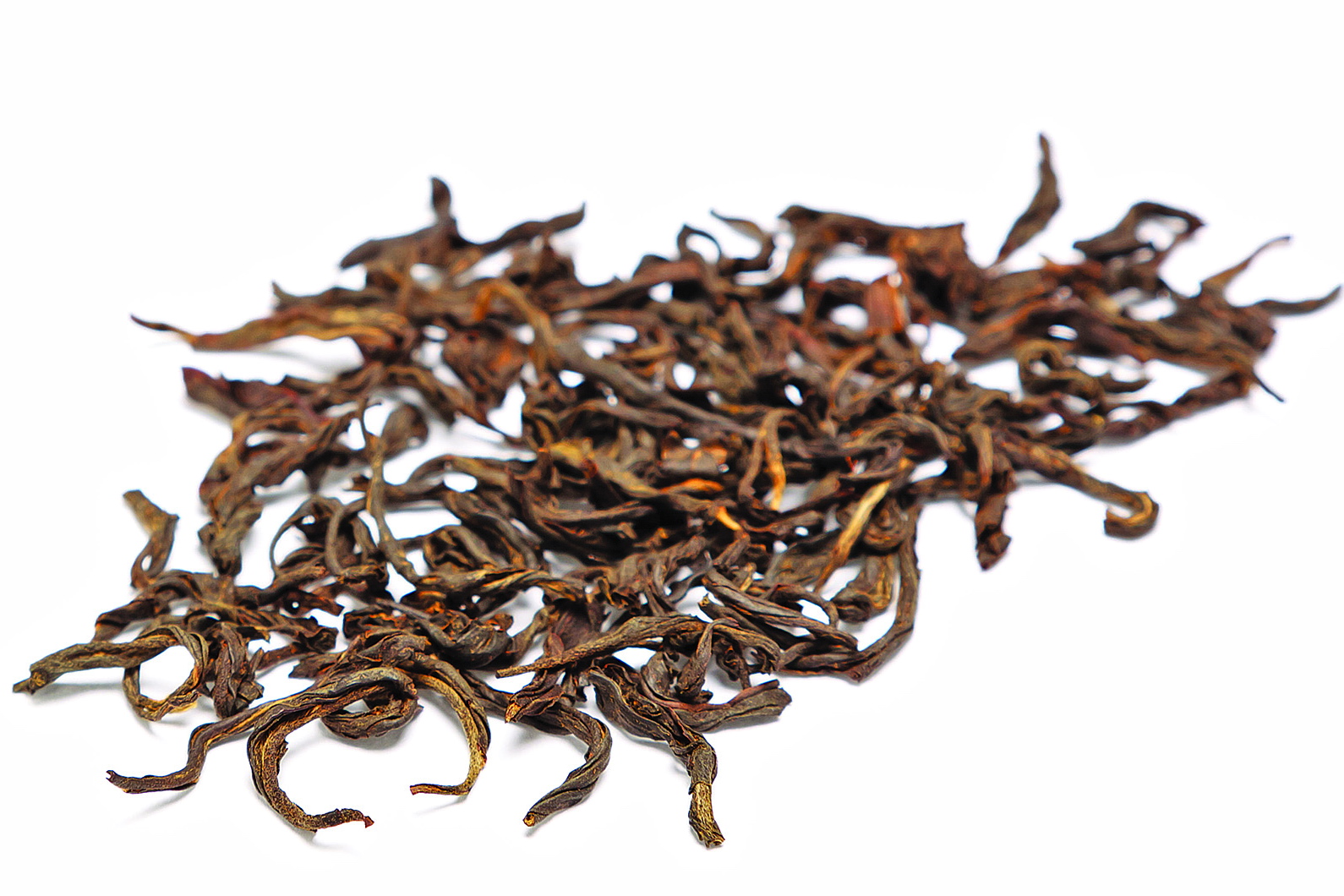
Tea production is a complex, labour-intensive process that varies considerably between tea types and individual varieties. Some varieties have histories stretching back centuries or even millennia. Chinese tea masters long guarded the particular techniques and secrets of their craft, which became more widely known outside China only relatively recently.
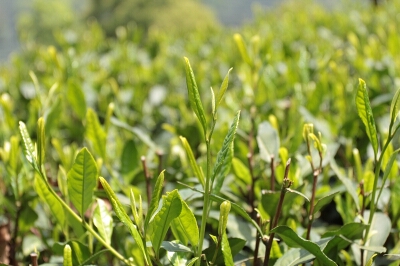
Longjing green tea bushes
The production process differs not only between white, green, yellow, oolong, black and pu-erh tea, but also between varieties within each group. Broadly speaking, the hundreds of Chinese tea varieties have a corresponding wealth of production methods.
Nevertheless, this diversity can be understood through a number of key stages, illustrated in our schematic
diagram of the production of different tea types:
Picking is carried out by hand for these traditional Chinese teas, helping to avoid damage to the leaves. The harvest is then sorted and cleaned, removing leaves that are too old or insect-damaged, together with coarse stems.
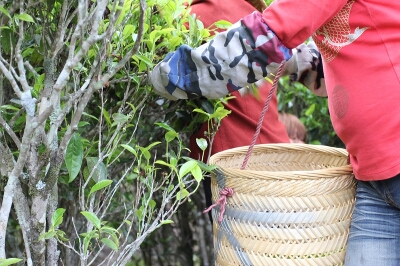
Picking Dan Cong oolong tea
Withering is a gentle initial drying of freshly picked leaves. Its main purpose is to reduce moisture: leaves can lose around half their moisture during this stage. They are usually withered in the shade, in a well-ventilated room or under a shelter, although some varieties are withered in sunlight.
Almost all Chinese loose-leaf teas undergo some degree of withering.
For green tea, the stage is very short or effectively absent: in some cases the leaves are rested for only two hours. Withering encourages oxidation, which is undesirable for green tea, so this stage may be combined with the initial sorting of the leaves.
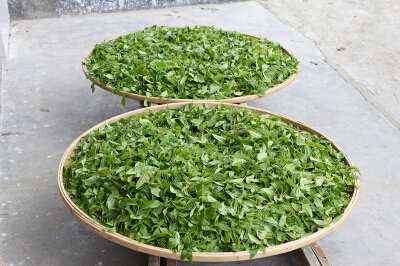
Withering Dan Cong tea
Lightly oxidised white teas undergo withering too. Unlike varieties for which withering is only a preparatory step, it is a principal processing stage for white tea. The leaves then go directly to drying, without rolling or a separate oxidation stage.
Withering is especially important in oolong and black tea production, helping to develop the character of each variety. It also makes the leaves more flexible so that they can be rolled and oxidised properly later.
Mechanical processing of the leaf is a crucial stage for most tea varieties. Rolling is the principal technique and may be done by hand or using special rolling machines. Hand-rolling is painstaking and labour-intensive, and remains important in high-quality traditional Chinese tea production. Leaves are repeatedly shaken, rolled and pressed with great care: damage during rolling can reduce the quality of the finished tea.
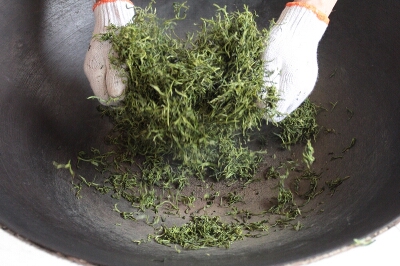
Rolling Bi Luo Chun green tea
Depending on the intended tea, rolling may perform several different functions:
- Giving the leaves their characteristic shape. Rolling methods vary widely: leaves may be twisted lengthwise or across their width, flattened completely, or allowed to retain their natural shape.
- Preparing the tea for oxidation. Rolling breaks some of the leaf’s cell walls, allowing the cell sap to react with oxygen and initiating the oxidative changes required for the next processing stage.
- Developing the tea’s aroma. The aromatic compounds in the leaf’s cell sap are a major source of its fragrance. Rolling expresses the sap and distributes it over the leaf surface. During brewing, these compounds are released into the infusion and contribute to its distinctive aroma.
- For oolong, shaking the leaves in baskets replaces the initial rolling stage. After withering, the leaves are shaken on bamboo trays, either by hand or in rotating equipment, to bruise their edges gently. Alternating periods of shaking and resting continue until the leaf surface becomes slightly yellow and the bruised edges develop a rusty colour as they react with oxygen.
- White teas do not undergo this mechanical processing stage.
Oxidation — often called fermentation in traditional tea terminology — refers here to the enzymatic oxidation of compounds in the tea leaf. It accounts for many of the chemical changes that define the finished variety.
Green teas undergo very little oxidation. Heating, through pan-firing or steaming, stops the process in a stage called sha qing, or ‘kill-green’.
White teas undergo limited oxidation during withering.
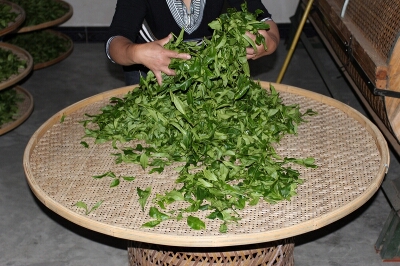
Oxidising Dan Cong oolong
For oolong and black tea, oxidation is one of the principal production stages and is central to their characteristic qualities.
In oolong, oxidation begins during shaking on bamboo trays. Because bruising is concentrated at the leaf edges, these areas oxidise more than the centre: this is why oolong is described as partially oxidised.
Black tea is oxidised in dim, well-ventilated rooms with high humidity, sometimes around 90%. Leaves may be spread in a layer about 10 cm deep and left for an extended period. They darken towards brown, while their aromas develop from grassy and floral notes into fruity, nutty and spicy ones.
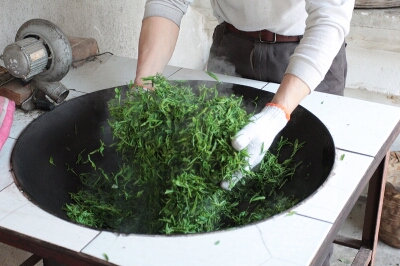
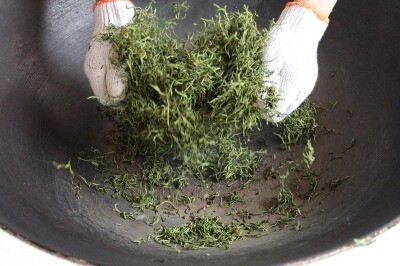
Pan-firing Bi Luo Chun green tea
Drying. Every tea undergoes a final drying stage. High-temperature drying stops further enzymatic activity and prepares the tea for packing and storage. This is a delicate balance: insufficiently dried tea spoils quickly and may develop mould, whereas excessive drying makes leaves brittle and can scorch them, creating an unpleasant burnt flavour. The desired finished leaf typically contains no more than about 2–5% moisture.
Most teas are dried using hot air in bamboo dryers or drying machines. Green teas are also commonly pan-fired in heated pans or dried on heated racks.
For white and black teas, drying has the additional role of stopping oxidation quickly and fixing the characteristic qualities of the variety.
Drying is equally important for oolongs, celebrated for their complex aromas. An intermediate stage may end with brief heating to remove moisture and stop oxidation, intensifying the flavour and aroma before the main rolling stage. Some flavoured oolongs receive additional treatment, such as milk-style flavouring or a coating of ginseng powder, producing milk oolong or ginseng oolong respectively.
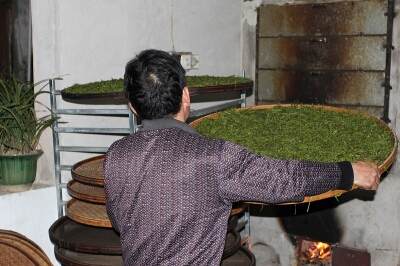
Oven-drying Dan Cong oolong
At this stage, tea is also prepared for packing and storage. Only properly dried tea can retain its qualities over a long period.
Pu-erh production is particularly complex. It uses leaves from large-leaf tea trees in Yunnan, followed by a lengthy sequence of processing stages. Ripe pu-erh also undergoes a distinctive microbial fermentation process known as wet-piling. After initial heating, rolling and sun-drying, the leaves are piled and held under moist conditions. Microorganisms contribute enzymes and drive complex chemical reactions. The resulting compounds give ripe pu-erh its characteristic aged aroma and a very smooth flavour with sweet notes.
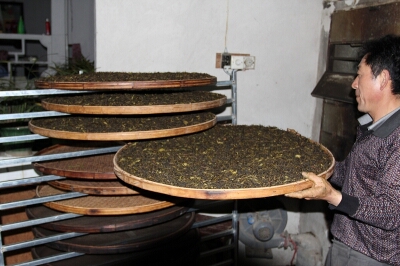
Oven-dried Dan Cong oolong
The final production stage involves carefully sorting, grading and, where appropriate, blending the finished tea. It is then tasted to assess its quality. Once approved, it is packed to preserve it for as long as possible. The tea now ‘sleeps’, ready to awaken again in your cup.
The quality tea available from iTea represents an enormous amount of work. Many people contribute their time, energy and skill, from the pickers on the plantation to the iTea team responsible for transporting and storing this valuable product.
Further reading:
Distinctive features of tea production in China.
Traditional Chinese teas are still made by hand using long-established techniques. An alternative is the mechanised processing widely adopted in India during the twentieth century. The CTC method — Crush, Tear, Curl — processes leaves rapidly into small, uniform particles. This differs fundamentally from the careful handling of whole leaves in traditional Chinese production. CTC allows large volumes to be made quickly and makes use of smaller pieces of leaf. William McKercher developed the method in the 1930s.
Another development associated with Western tea drinking was the tea bag, commonly linked to the American merchant Thomas Sullivan. Bags made it convenient to use smaller leaves and tea particles. Mass demand and the drive to reduce production costs helped establish machine-processed bagged tea as a familiar product in the West, quite different in character from traditional whole-leaf tea.
Oxidation
Leaves are spread on racks in a well-ventilated room with high humidity and carefully controlled temperature. Chemical reactions take place within the leaves and their expressed sap, forming compounds responsible for black tea’s reddish-brown infusion and fruity, spicy aromas.
The process requires humidity, a relatively moderate temperature and adequate aeration. It commonly lasts 3–5 hours. The conditions described here are 22–26°C and relative humidity of 96–98%, although individual production methods vary.
The biochemistry is complex. In brief, enzymes help tea polyphenols react with oxygen, producing compounds including theaflavins and thearubigins, which contribute to the characteristic colour of black tea.